01
LiDAR & laser scanning
Point clouds from terrestrial or drone-mounted LiDAR and laser scanners are turned into accurate, as-built equipment models.

Credo3D accepts 3D models from the sources you already use, without re-modelling.
Point clouds from terrestrial or drone-mounted LiDAR and laser scanners are turned into accurate, as-built equipment models.
Export models from standard systems such as — AVEVA™, Navisworks™, AutoCAD™, SolidWorks™, Revit™, PDMS™ and E3D™ —
Standard photographs are transformed automatically into 3D models — no specialist capture equipment needed.
Photogrammetry, drone imagery and neutral formats such as STEP, IFC, OBJ and glTF complete the picture.
Boost productivity and accuracy
AI-assisted report writing. Spelling and grammar checking. Sentence auto-completion, plus a final review and formatting pass.
Spelling · grammar · auto-completion · formatting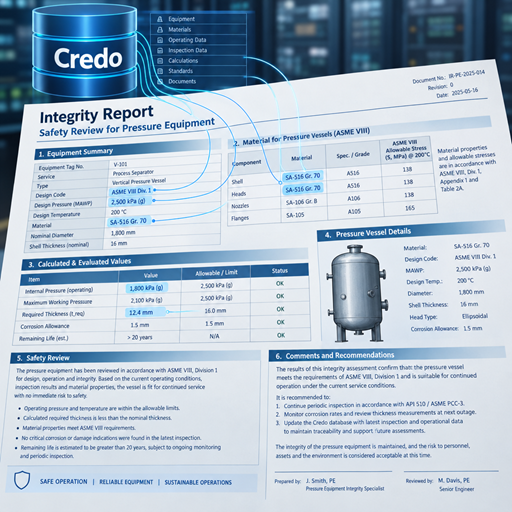
Cross-checks the material of construction against the governing design code. A designation the code does not recognise is flagged before it propagates into design.
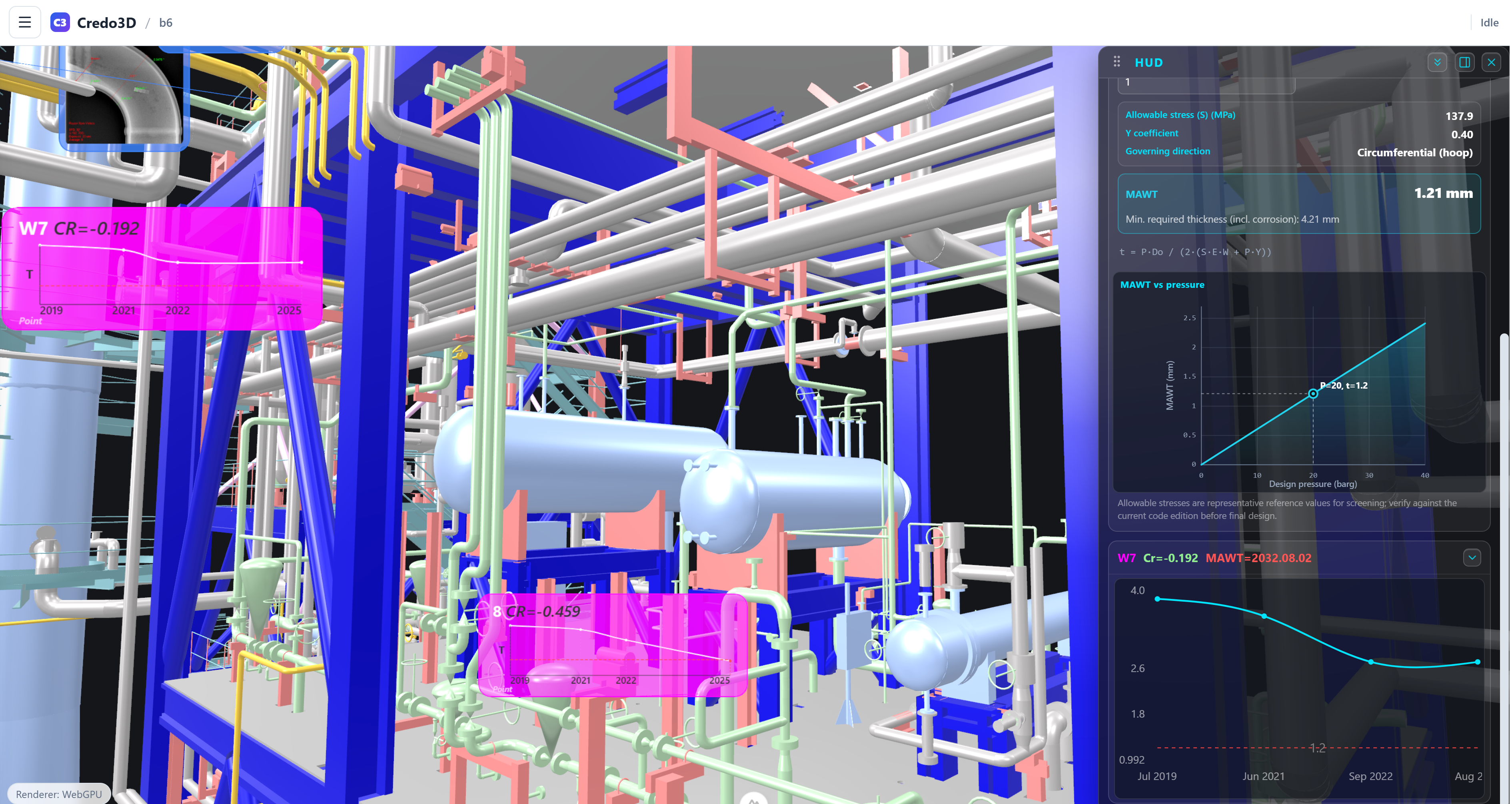
ASME B31.3 · API 570 · API 581Calculates MAWT from design pressure, diameter and material properties — and flags thickness that does not reconcile with the recorded corrosion allowance and remaining life.
MAWT · tmin · remaining lifeSense-checks assigned corrosion rates against inspection history. A rate that is physically impossible — negative, or one that contradicts the recorded end-of-life — is caught.
mm/yr · API 581Productivity and accuracy. Cross-checks design data, calculates MAWT and corrosion rates, and flags inconsistencies.
Combines traditional integrity data with 3D visualisation.
Runs API 581 damage-mechanism models against your equipment data.
Tracks thickness data and predicts time to MAWT.
API RP 584. Live process conditions against integrity limits, with alarms and time-at-limit tracking when a limit is exceeded.
Connect SAP™, Maximo™, PI™ and OpenText™, and explore SQL Server data.
A powerful data science tool that expands the power of API 581 RBI.
Drag and drop files into 3D models and make permanent connections.
API 581 methodology. Quantitative consequence and probability calculation, with automatic mitigating inspection plans.
Inspection tasks, approvals and follow-up actions that move through your team in a controlled, auditable flow.
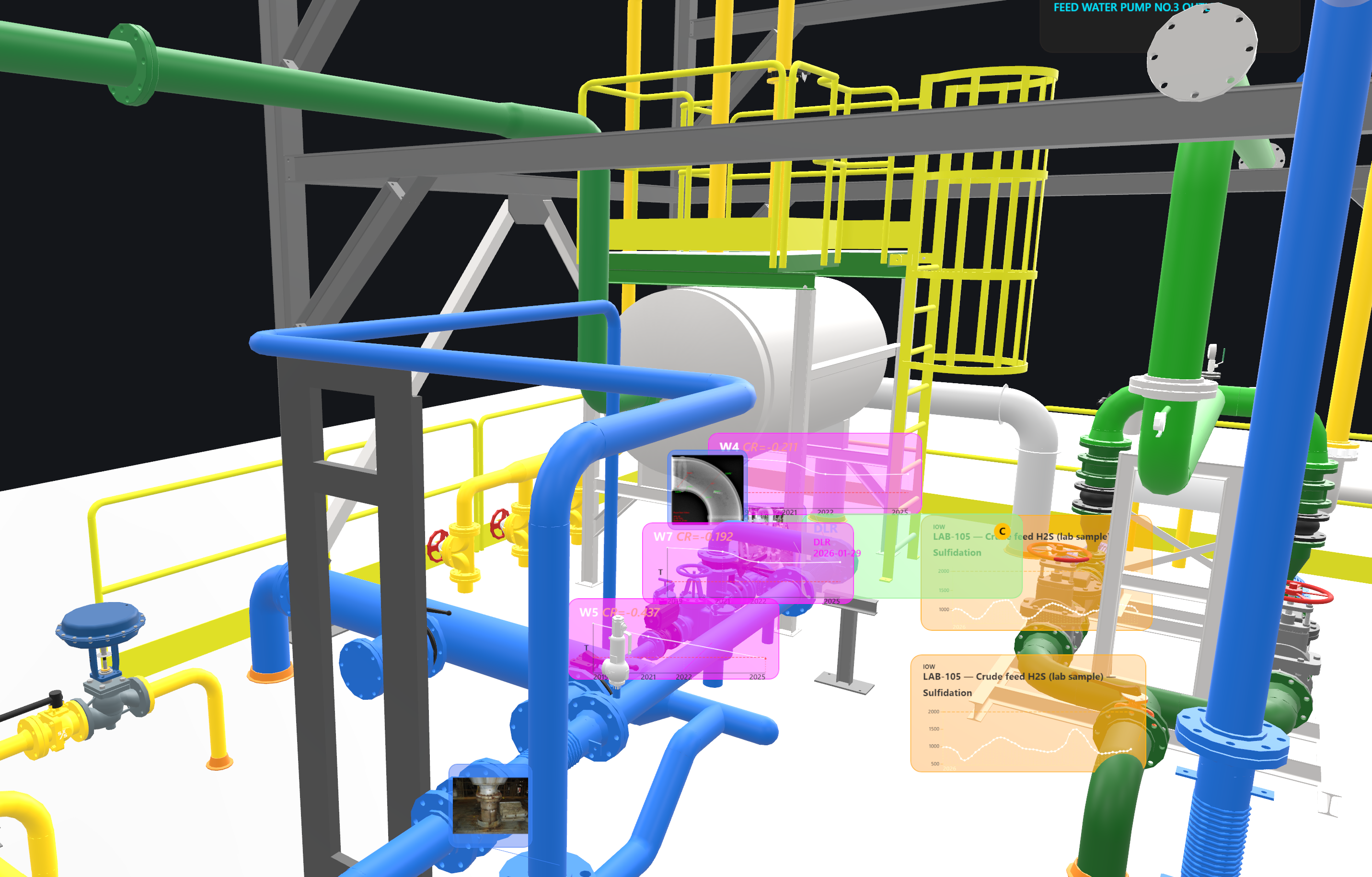
Attach photographs to the model — pinned to the exact equipment and location.
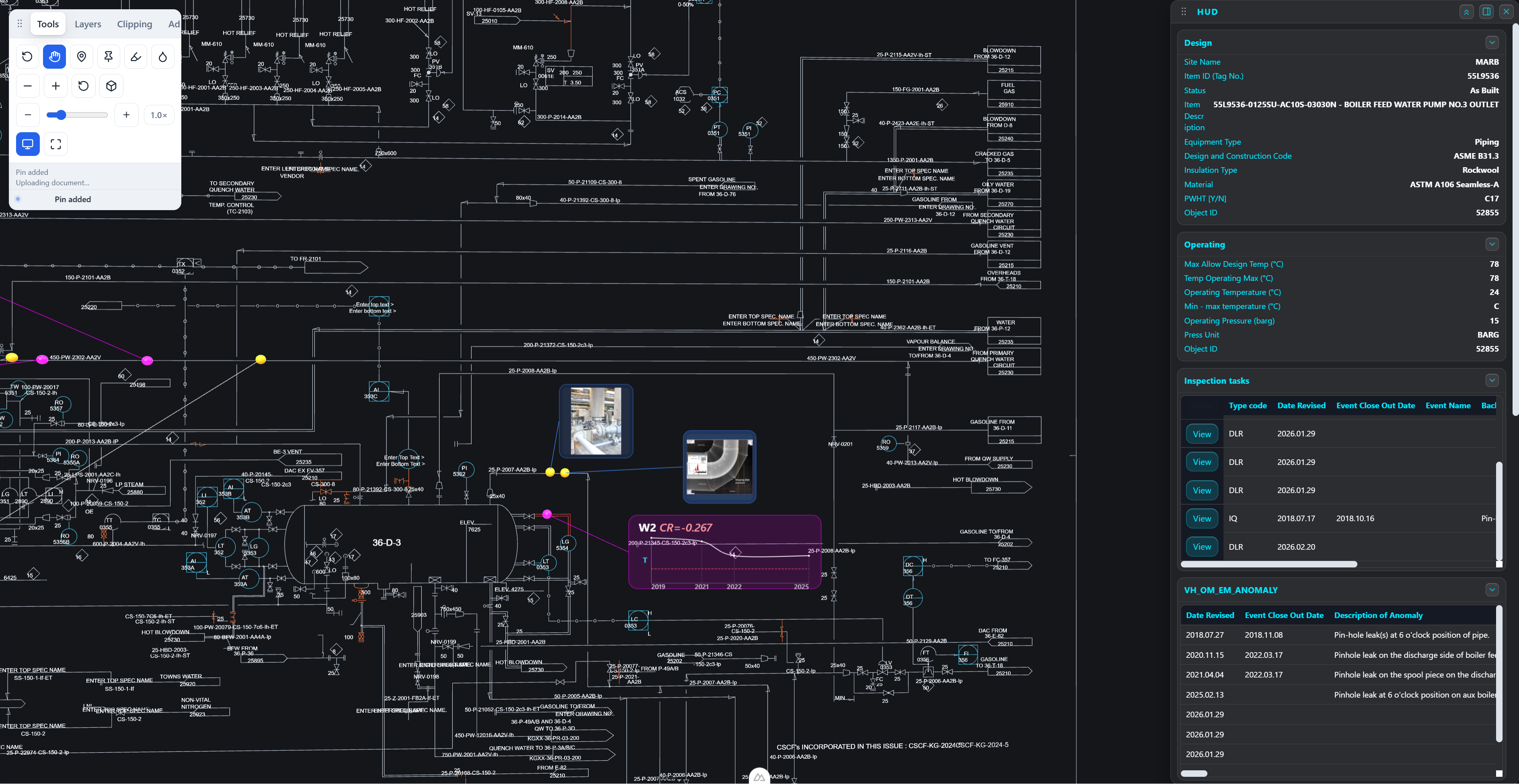
Spin the model and look inside — highlight anomalies and connect to photos and reports.
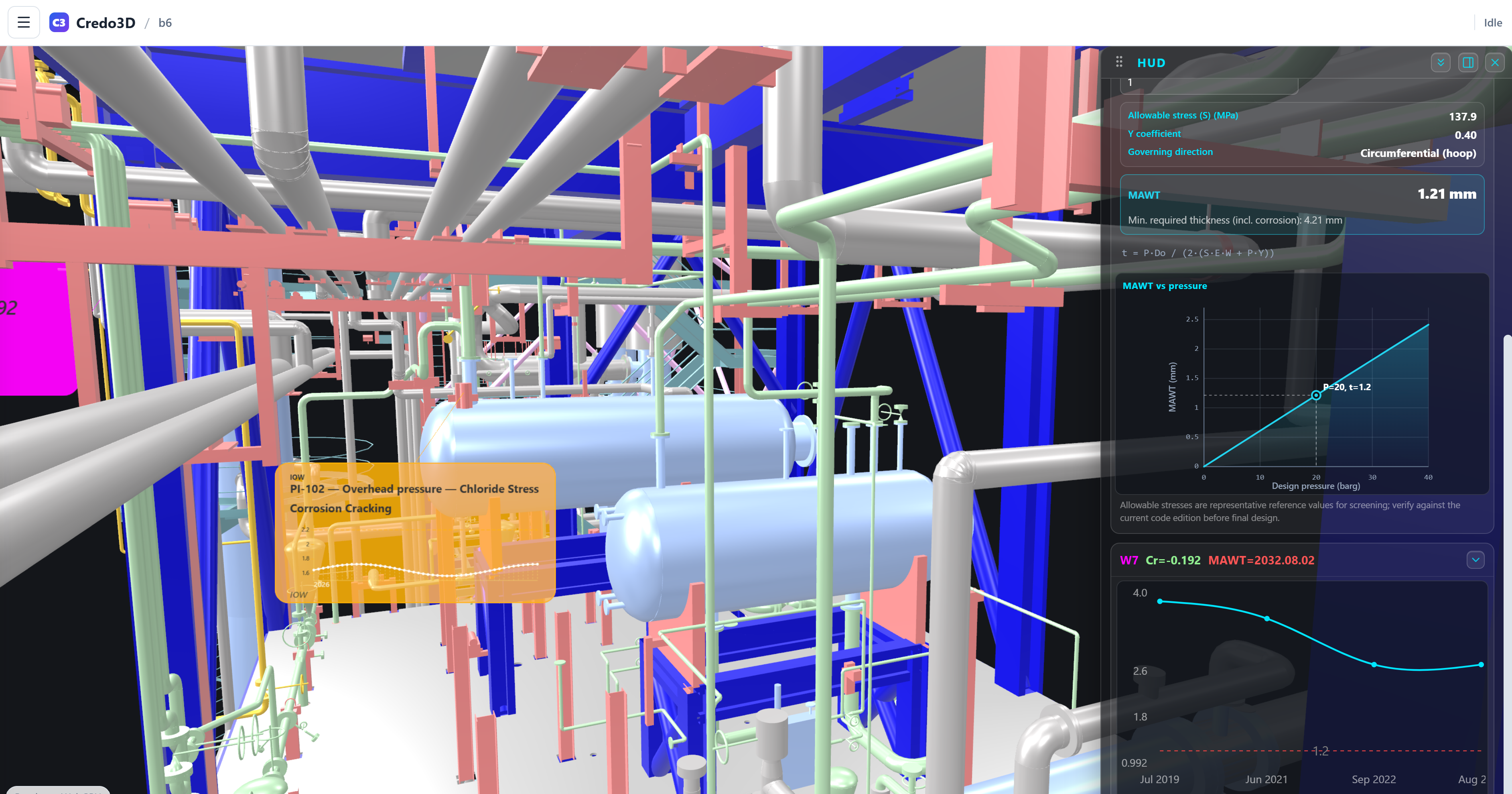
Fully implemented Integrity Operating Window management — connect data sources to the correct position on the model.
Group data classes in layers such as corrosion data, anomaly reports and IOW data sources.
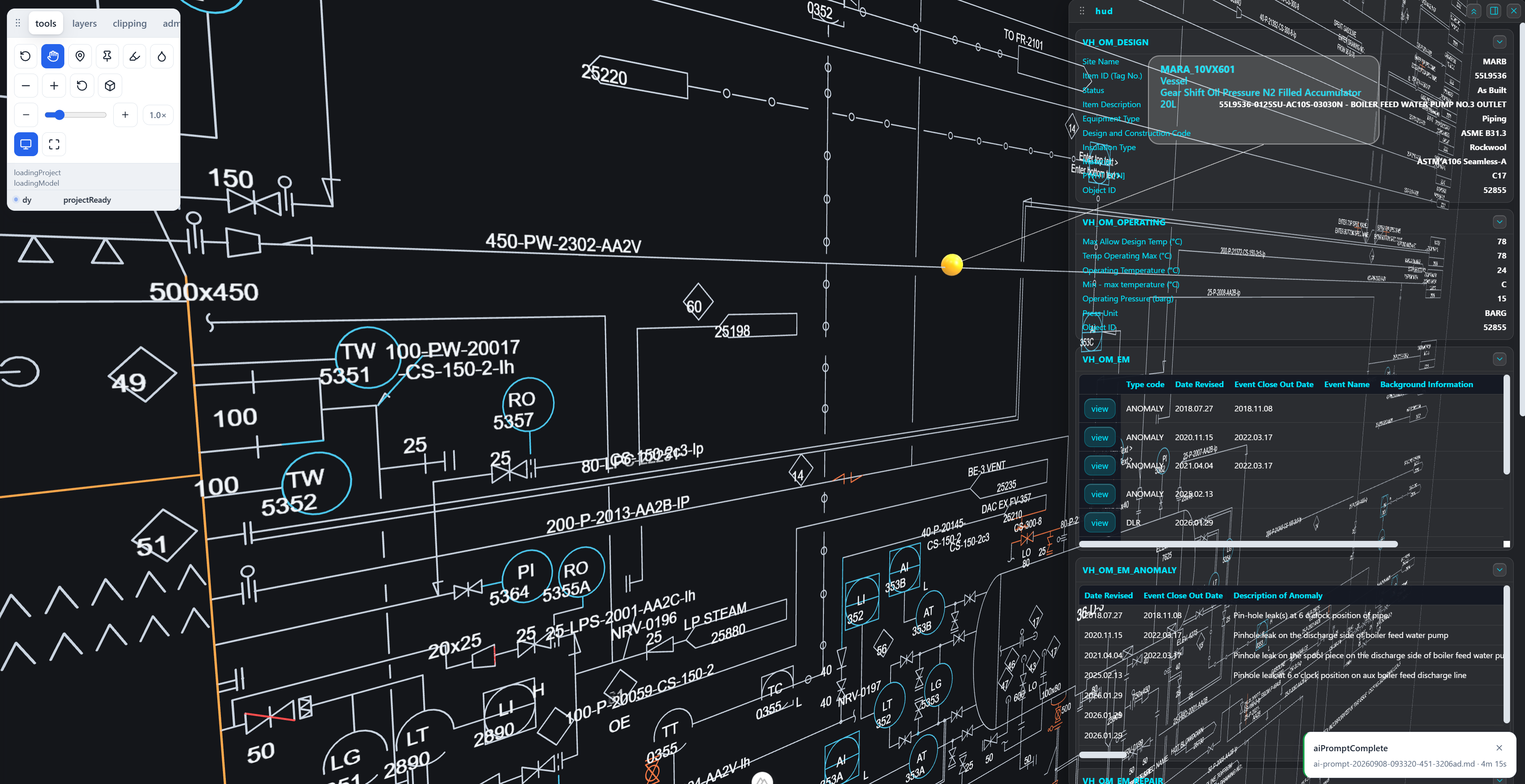
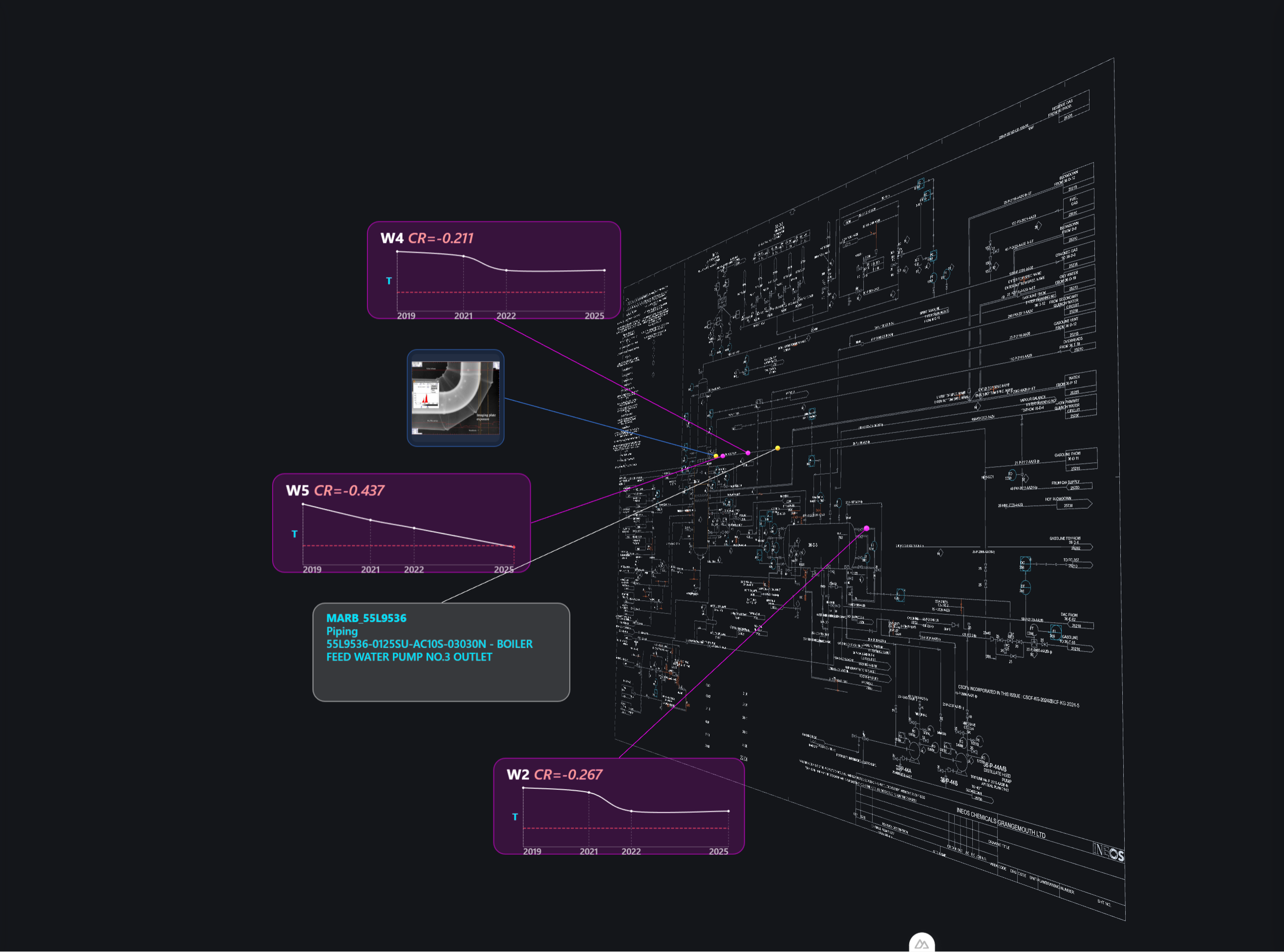
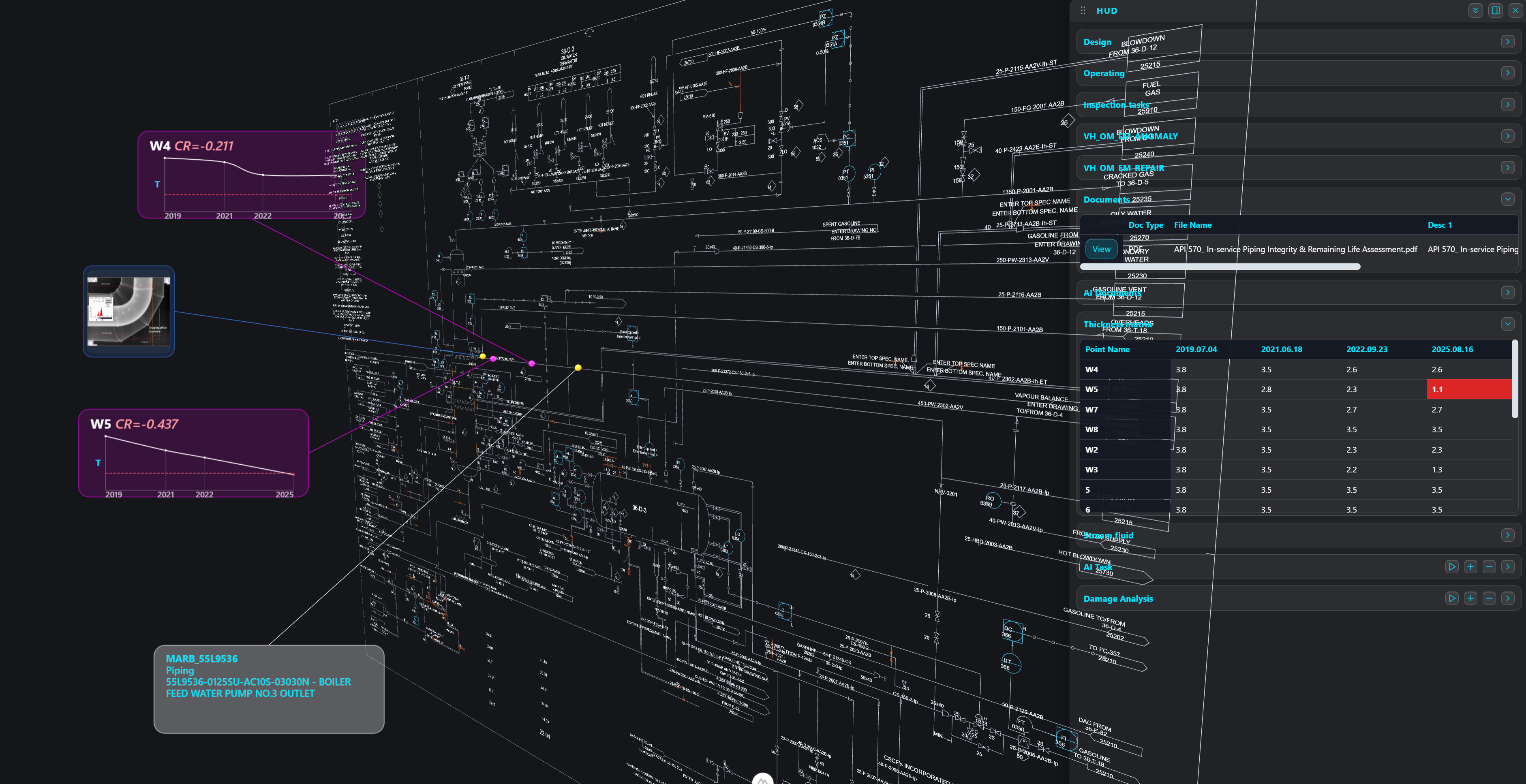
Zoomable P&IDs, tied to the equipment you are inspecting.
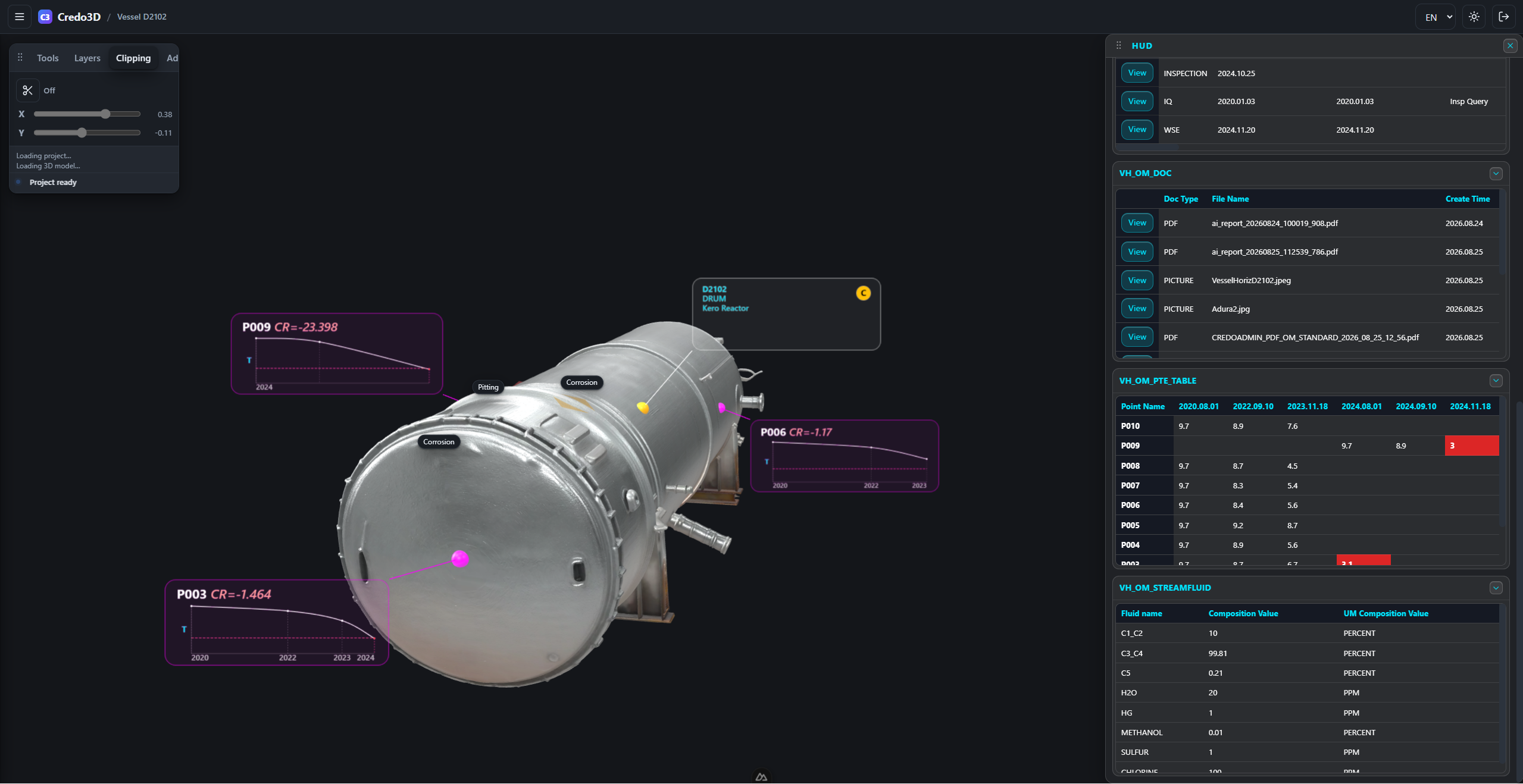
Interact with the model to explore data — inside and out.
Thickness trends and corrosion, mapped onto the equipment.
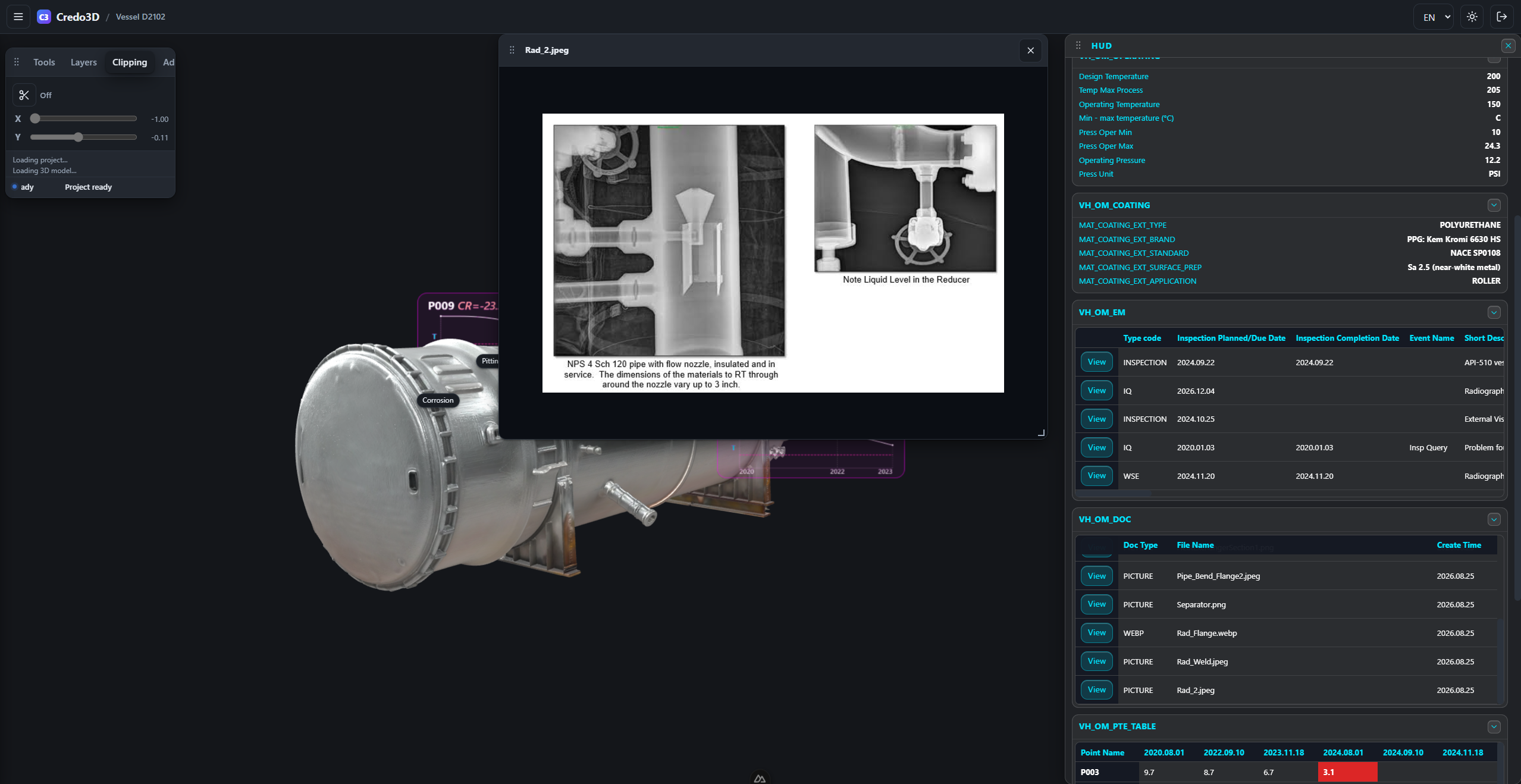
Radiography films, opened in place on the model.
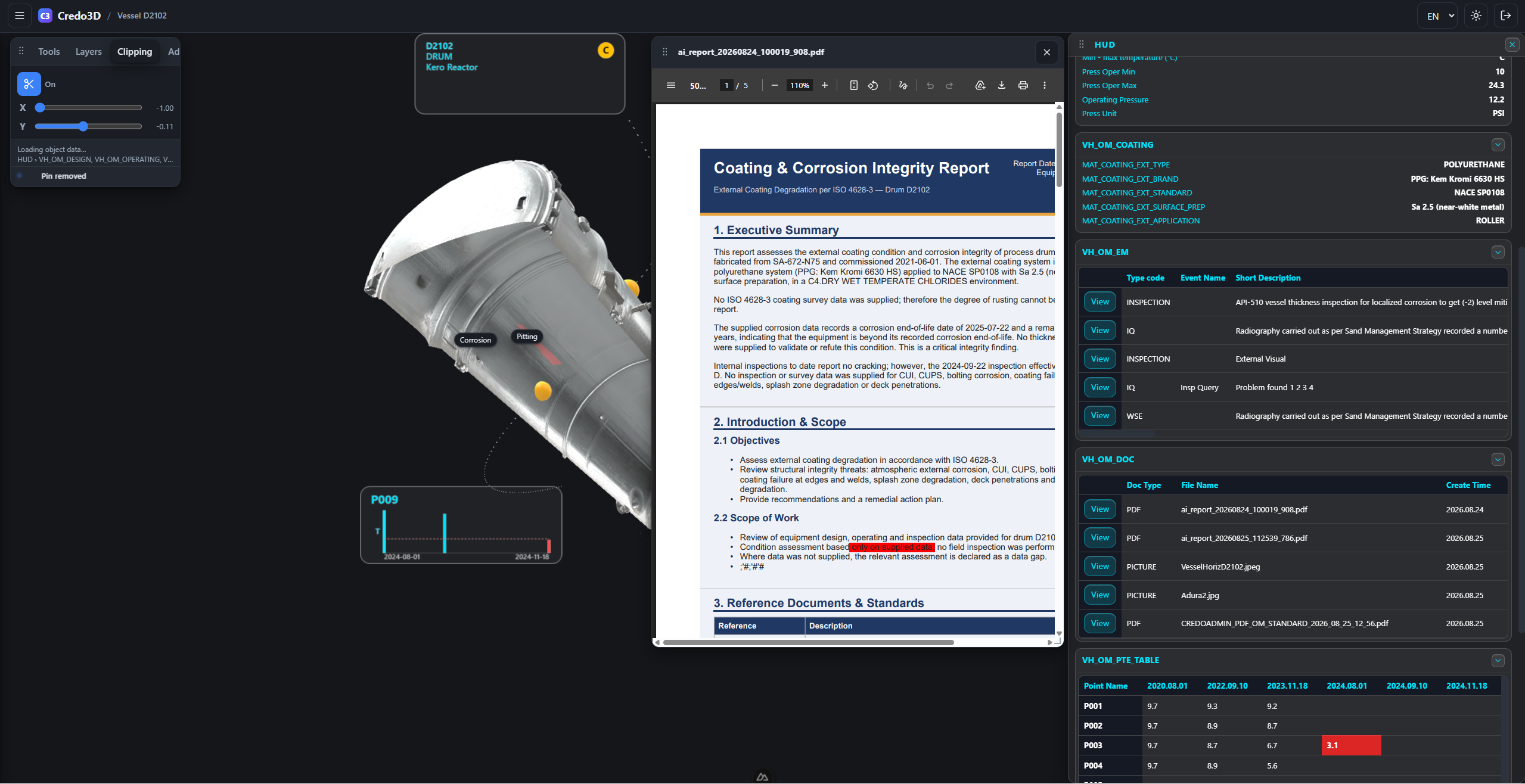
Reports opened in place — without leaving the model.
Plan, assign and track integrity tasks — from inspection scheduling through to close-out.
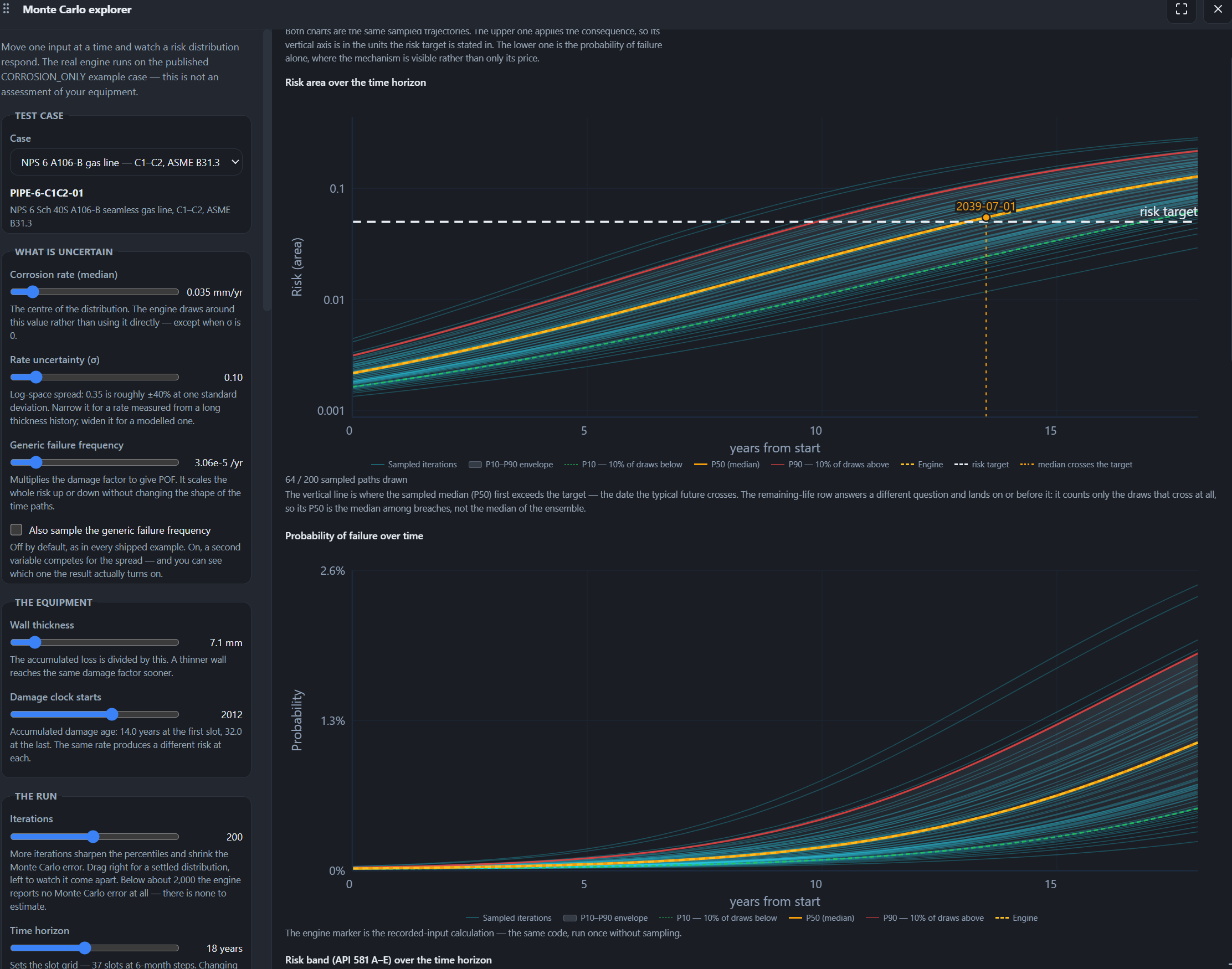
API 581 damage models, sampled thousands of times — the range of outcomes and the probability of each.
Oil & gas, chemicals and service companies across refining, exploration & production, and utilities.
A digital twin of pressure equipment — a live, synchronised digital representation that replays history and forecasts remaining life, framed against ISO 23247 and ISO/IEC 30173.
Pressure equipment, measurement points and equipment tags.
Live3D model, HUD and the structured IOW data model.
LiveEquipment and integrity points — the IOW schema.
LiveThe Credo3D viewer, HUD and data layer.
LiveLive historian link — one-way, read-only — when integrated with PI.
LiveLive status at the appropriate rate (≤ 60 s), when integrated with PI.
LiveHistorian adapter — PI Web API or file drop — when integrated with PI.
LiveIngestion of readings into the time-series store, when integrated with PI.
LiveDamage mechanisms — screening plus corrosion-rate, damage-factor and susceptibility models, run on the selected equipment.
LiveCorrosion progression, crack growth and thermal models — built on the API 581 damage engine.
SpecifiedActuating plant equipment — outside the integrity team’s role.
Out of scopeAPI 581 damage-mechanism models, run against equipment data — screening each mechanism for applicability, then quantifying corrosion rate, damage factor and susceptibility.
Taking API 581 to the next level by quantifying the true range of possible risk outcomes.
API 581 damage models, sampled thousands of times — the range of outcomes and the probability of each.
Fast simulation based on the Credo Integrity data. Visualise results in a detailed dashboard. Control the simulation with a confidence level and a date range.
The Monte Carlo simulation is a powerful data science tool that is used to quantify the uncertainty in the API 581 risk assessment.
Safety is a question about the tail of a distribution, not its middle — the mean serves the cost objective, the tail serves the safety constraint. Simulation reports the probability that a risk target or a thickness limit is crossed by a given date, held against a tolerance the company sets for itself.
An inspection interval is a spending decision. Simulation moves intervals in both directions, shows which inputs actually drive the answer, and sizes turnaround scope at a confidence the business can budget against.
The method is mature and the framework already exists. Simulation runs the same API 581 engine the compliance result comes from — no second physics to maintain, and no second answer to reconcile.
| The question | Deterministic · API 581 | Probabilistic · Monte Carlo |
|---|---|---|
| When must we act? | A date | A date at a confidence we chose |
| How much risk are we carrying? | A band | The probability of each band |
| Where should the budget go? | A risk ranking | A ranking by value, not by severity alone |
In one line API 581 answers the standard’s question. Monte Carlo answers the operator’s.
Credo8 remains the core data-management platform. Credo3D + AI is not a replacement — it is an additional visualisation and analytical layer.
An additional visualisation layer for equipment, running on top of Credo8. The AI engine adds analytical power to that data.
The core data-management platform — a mature, proven, data-centric architecture and the primary integrity management tool.
Credo3D is deployed in parallel to the existing Credo8 system. The deployment is streamlined and brings zero disruption to the existing Credo8 system.
100% rebuild in 2026 using the latest high performance web technologies. Faster response times, scalable and secure.
Credo3D implements the latest WebGPU graphics engine that takes advantage of modern hardware capabilities.
The platform scales out to serve teams of any size — from a single site to a global enterprise.
Many engineers can open, inspect and update the same equipment data at the same time — safely and without conflict.
Work is shared and cached across the server, so heavy use stays responsive and running costs stay controlled.
The client loads only the detail you are looking at, so even large models stay smooth on ordinary hardware and connections.
The fastest way to get started. CredoSoft runs, secures and updates the platform for you — you just connect your team.
Full control for regulated environments. The platform runs inside your network, on your hardware, behind your firewall.
Thirty years of successful global deployments — hundreds of projects, from single plants to multinational enterprises.
The system is only as good as the data it holds. Moving, merging and shaping the multi-year archive is the milestone every later capability depends on.
Legacy data lives in spreadsheets, documents and disconnected database silos. If they are not genuinely merged, the new system relocates the fragmentation rather than removing it.
Long projects lose momentum, key people and executive support. Delivering a working core early, then enhancing incrementally, keeps the project alive and trusted.
A private company dedicated exclusively to building the most innovative asset integrity management solutions.
Quality Management
Information Security Management
Our headquarters is in Edinburgh, with a support office in Dubai.
We develop, deploy and support Credo ourselves — no subcontractors, no partnerships.
A long list of clients worldwide — and we are proud that many have been customers for 30 years.